Monday, 18 July 2011

Airbus A380 Testing


Testing

A380 MSN001 about to land after itsmaiden flight
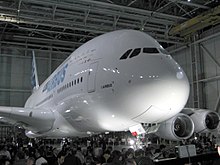
Five A380s were built for testing and demonstration purposes. The first A380, serial number MSN001 and registration F-WWOW, was unveiled at a ceremony in Toulouse on 18 January 2005. Its maiden flight took place at 8:29 UTC (10:29 am local time) 27 April 2005.[34]This plane, equipped with Trent 900 engines, flew from Toulouse Blagnac International Airport with a flight crew of six headed by chief test pilotJacques Rosay. After successfully landing three hours and 54 minutes later, Rosay said flying the A380 had been “like handling a bicycle” .
On 1 December 2005 the A380 achieved its maximum design speed of Mach 0.96 (versus typical cruising speed of Mach 0.85), in a shallow dive, completing the opening of the flight envelope. In 2006, the A380 flew its first high altitude test at Bole International Airport, Addis Ababa. It conducted its second high altitude test at the same airport in 2009. It arrived in North America on 6 February 2006, landing inIqaluit, Nunavut in Canada for cold-weather testing.
Flight test engineer's station on the lower deck of A380 F-WWOW
On 14 February 2006, during the destructive wing strength certification test on MSN5000, the test wing of the A380 failed at 145% of the limit load, short of the required 150% to meet the certification. Airbus announced modifications adding 30 kg to the wing to provide the required strength. On 26 March 2006 the A380 underwent evacuation certification in Hamburg. With 8 of the 16 exits blocked, 853 passengers and 20 crew left the aircraft in 78 seconds, less than the 90 seconds required by certification standards. Three days later, the A380 received European Aviation Safety Agency (EASA) and United States Federal Aviation Administration(FAA) approval to carry up to 853 passengers.
The maiden flight of the first A380 using GP7200 engines—serial number MSN009 and registration F-WWEA—took place on 25 August 2006. On 4 September 2006, the first full passenger-carrying flight test took place. The aircraft flew from Toulouse with 474 Airbus employees on board, in the first of a series of flights to test passenger facilities and comfort. In November 2006 a further series of route proving flights took place to demonstrate the aircraft's performance for 150 flight hours under typical airline operating conditions.
Airbus obtained type certificates for the A380-841 and A380-842 model from the EASA and FAA on 12 December 2006 in a joint ceremony at the company's French headquarters. The A380-861 model obtained the type certificate 14 December 2007.

Airbus A380 Production


Production

Diagram showing flow of aircraft part in western Europe. Land is white, with the sea being pale blue
Geographical logistics sequence for the A380, with final assembly in Toulouse
Major structural sections of the A380 are built in France, Germany, Spain, and the United Kingdom. Due to their size, they are brought to the assembly hall (the Jean-Luc Lagardère Plant) in Toulouse in France by surface transportation, though some parts are moved by the A300-600ST Beluga aircraft used in the construction of other Airbus models. Components of the A380 are provided by suppliers from around the world; the five largest contributors, by value, are Rolls-Royce, Safran, United Technologies, General Electric and Goodrich.
Transporting A380 components from the port of Bordeaux.
For the surface movement of large A380 structural components, a complex route known as the Itinéraire à Grand Gabarit was developed. This involved the construction of a fleet of roll-on/roll-off (RORO) ships and barges, the construction of port facilities and the development of new and modified roads to accommodate oversized road convoys.
The front and rear sections of the fuselage are loaded onto one of three roll-on/roll-off (RORO) ships in Hamburg in northern Germany, from where they are shipped to the United Kingdom. The wings, which are manufactured at Filton in Bristol andBroughton in North Wales, are transported by barge to Mostyn docks, where the ship adds them to its cargo. In Saint-Nazaire in western France, the ship trades the fuselage sections from Hamburg for larger, assembled sections, some of which include the nose. The ship unloads in Bordeaux. Afterwards, the ship picks up the belly and tail sections by Construcciones Aeronáuticas SA in Cádiz in southern Spain, and delivers them to Bordeaux. From there, the A380 parts are transported by barge to Langon, and by oversize road convoys to the assembly hall in Toulouse.
After assembly, the aircraft are flown to Hamburg Finkenwerder Airport (XFW) to be furnished and painted. It takes 3,600 L (950 US gal) of paint to cover the 3,100 m2 (33,000 sq ft) exterior of an A380. Airbus sized the production facilities and supply chain for a production rate of four A380s per month.

Airbus A380

The Airbus A380 is a double-deck, wide-body, four-engine jet airliner manufactured by the European corporation Airbus, a subsidiary of EADS. It is the largest passenger airliner in the world. Designed to challenge Boeing's monopoly in the large-aircraft market, the A380 made its maiden flight on 27 April 2005 and entered commercial service in October 2007 with Singapore Airlines. The aircraft was known as the Airbus A3XX during much of its development, before receiving the A380 model number. The nickname Superjumbo has since become associated with it.
The A380's upper deck extends along the entire length of the fuselage, and its width is equivalent to that of a widebody aircraft. This allows for an A380-800's cabin with 5,146 square feet (478.1 m2) of floor space; 49% more floor space than the current next-largest airliner, the Boeing 747-400 with 3,453 square feet (320.8 m2), and provides seating for 525 people in a typical three-class configuration or up to 853 people in all-economy class configurations. The A380-800 has a design range of 15,200 km (8,200 nmi; 9,400 mi), sufficient to fly from New York to Hong Kong for example, and a cruising speed of Mach 0.85 (about 900 km/h or 560 mph at cruising altitude).
As of July 2011 the A380 has received 236 firm orders, of which 53 had been delivered. The largest order came from Emirates, which has 90 aircraft on order.


Background

In the summer of 1988, a group of Airbus engineers led by Jean Roeder began working in secret on the development of a ultra-high-capacity airliner (UHCA), both to complete its own range of products and to break the dominance that Boeing had enjoyed in this market segment since the early 1970s with its 747.McDonnell Douglas unsuccessfully offered its smaller, double-deck MD-12 concept for sale. Roeder was given approval for further evaluations of the UHCA after a formal presentation to the President and CEO in June 1990. The megaproject was announced at the 1990 Farnborough Air Show, with the stated goal of 15% lower operating costs than the 747-400. Airbus organised four teams of designers, one from each of its partners (Aérospatiale, Deutsche Aerospace AG, British Aerospace, CASA) to propose new technologies for its future aircraft designs. The designs would be presented in 1992 and the most competitive designs would be used.
In January 1993, Boeing and several companies in the Airbus consortium started a joint feasibility study of an aircraft known as the Very Large Commercial Transport (VLCT), aiming to form a partnership to share the limited market. This joint study was abandoned two years later, Boeing's interest having decreased because analysts thought that such a product would unlikely earn the $15-billion in development costs. Despite the fact that only two airlines had expressed public interest in purchasing such a plane, Airbus was already pursuing its own large plane project. Analysts suggested that Boeing instead would pursue stretching their 747 design, and that air travel was already moving away from the hub and spoke system that consolidated traffic into large planes, and toward more non-stop routes that could be served by smaller planes.

In June 1994, Airbus began developing its own very large airliner, designated the A3XX. Airbus considered several designs, including an odd side-by-side combination of two fuselages from the A340, which was Airbus’s largest jet at the time. The A3XX was pitted against the VLCT study and Boeing’s own New Large Aircraft successor to the 747.From 1997 to 2000, as the East Asian financial crisis darkened the market outlook, Airbus refined its design, targeting a 15 to 20% reduction in operating costs over the existing Boeing 747-400. The A3XX design converged on a double-decker layout that provided more passenger volume than a traditional single-deck design, in line with traditional hub-and-spoketheory as opposed to the point-to-point theory of the Boeing 777, after conducting an extensive market analysis with over 200 focus groups.


Design phase

On 19 December 2000, the supervisory board of newly restructured Airbus voted to launch a €8.8-billion programme to build the A3XX, re-christened as the A380, with 50 firm orders from six launch customers.
The A380 designation was a break from previous Airbus families, which had progressed sequentially from A300 to A340. It was chosen because the number 8 resembles the double-deck cross section, and is a lucky number in some Asian countries where the aircraft was being marketed. The aircraft’s configuration was finalised in early 2001, and manufacturing of the first A380 wing box component started on 23 January 2002. The development cost of the A380 had grown to €11 billion when the first aircraft was completed.