
The A380's upper deck extends along the entire length of the fuselage, and its width is equivalent to that of a widebody aircraft. This allows for an A380-800's cabin with 5,146 square feet (478.1 m2) of floor space; 49% more floor space than the current next-largest airliner, the Boeing 747-400 with 3,453 square feet (320.8 m2), and provides seating for 525 people in a typical three-class configuration or up to 853 people in all-economy class configurations. The A380-800 has a design range of 15,200 km (8,200 nmi; 9,400 mi), sufficient to fly from New York to Hong Kong for example, and a cruising speed of Mach 0.85 (about 900 km/h or 560 mph at cruising altitude).
As of July 2011 the A380 has received 236 firm orders, of which 53 had been delivered. The largest order came from Emirates, which has 90 aircraft on order.
Background

In the summer of 1988, a group of Airbus engineers led by Jean Roeder began working in secret on the development of a ultra-high-capacity airliner (UHCA), both to complete its own range of products and to break the dominance that Boeing had enjoyed in this market segment since the early 1970s with its 747.McDonnell Douglas unsuccessfully offered its smaller, double-deck MD-12 concept for sale. Roeder was given approval for further evaluations of the UHCA after a formal presentation to the President and CEO in June 1990. The megaproject was announced at the 1990 Farnborough Air Show, with the stated goal of 15% lower operating costs than the 747-400. Airbus organised four teams of designers, one from each of its partners (Aérospatiale, Deutsche Aerospace AG, British Aerospace, CASA) to propose new technologies for its future aircraft designs. The designs would be presented in 1992 and the most competitive designs would be used.
In January 1993, Boeing and several companies in the Airbus consortium started a joint feasibility study of an aircraft known as the Very Large Commercial Transport (VLCT), aiming to form a partnership to share the limited market. This joint study was abandoned two years later, Boeing's interest having decreased because analysts thought that such a product would unlikely earn the $15-billion in development costs. Despite the fact that only two airlines had expressed public interest in purchasing such a plane, Airbus was already pursuing its own large plane project. Analysts suggested that Boeing instead would pursue stretching their 747 design, and that air travel was already moving away from the hub and spoke system that consolidated traffic into large planes, and toward more non-stop routes that could be served by smaller planes.
Design phase
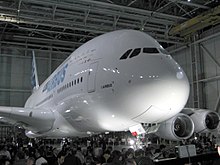
On 19 December 2000, the supervisory board of newly restructured Airbus voted to launch a €8.8-billion programme to build the A3XX, re-christened as the A380, with 50 firm orders from six launch customers.
The A380 designation was a break from previous Airbus families, which had progressed sequentially from A300 to A340. It was chosen because the number 8 resembles the double-deck cross section, and is a lucky number in some Asian countries where the aircraft was being marketed. The aircraft’s configuration was finalised in early 2001, and manufacturing of the first A380 wing box component started on 23 January 2002. The development cost of the A380 had grown to €11 billion when the first aircraft was completed.

No comments:
Post a Comment